Observing ABT dancers in company class on Wednesday, what struck me the most was not the 180-degree turn-out (ubiquitous), nor the extensions (extravagant), nor the pirouettes (I lost count), nor the men’s hands grazing the ceiling light fixtures every time they launched into an assemblé or grand jeté (we’re talking 16-foot ceilings at the ABT studios).
What leapt out at me was how the dancers held their backs – so strongly upright, even as their legs were lifting and circling. Ordinary mortals walk around thinking they’re standing up straight until they see a studio full of professional dancers and realize that they’ve actually spent their entire life hunched over.
Ballet develops not only strong back extensors, but also strong abdominals, exceptional mobility in the hips, and an ability to fine-tune one’s weight placement to avoid visible, aesthetically jarring compensations in the torso. In order to lift the leg to the back, for instance, an ordinary person would have to bend forward from the hips; a ballet dancer uses her strong spinal extensors to minimize this forward tilt and isolate it in the pelvis, moving the upper torso slightly forward and “lifting the heart,” creating the beautiful arch of an arabesque or attitude.
Because different sections of the spine curve in different directions, supporting it involves a delicate balancing act of muscular co-contraction. Dancers learn to engage the muscles around the spine in a precise way that protects it from injury, while creating a long lifted look. The abs must be pulled in just enough to protect the lumbar spine, but too much action from the abs can pull the ribs down, whereas too much extension of the thoracic spine (middle back) can draw the shoulders too far back.
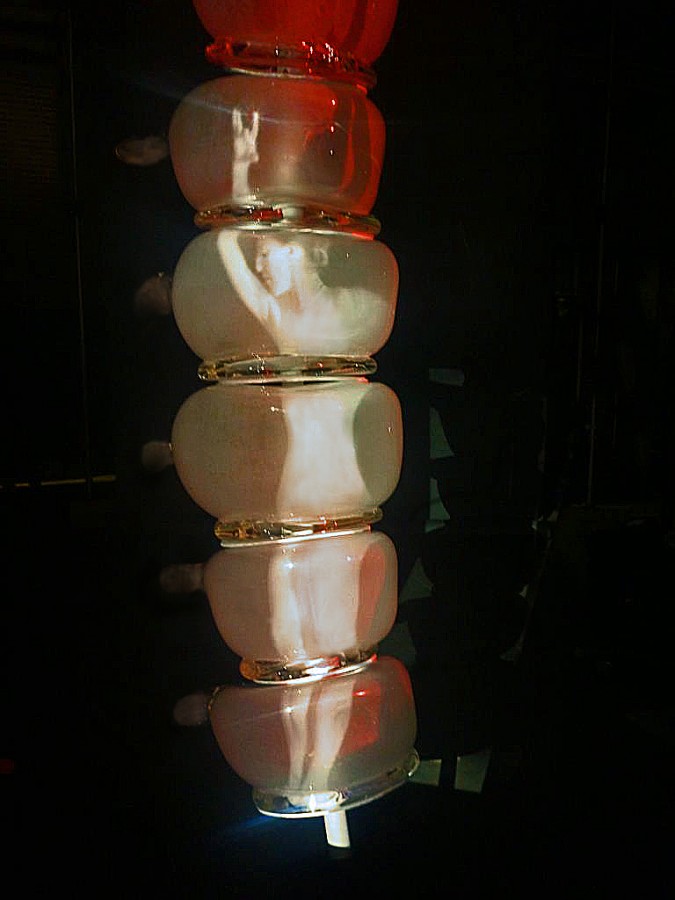
Coincidentally, that same night, after being impressed by ABT’s spinal alignment, I came face-to-face with a gigantic spine – made of transparent glass – about 14 feet tall, with the moving image of a ballerina trapped within the glass, rippling her arms and reaching skyward. No, I had not had one glass of Margaux too many at the cozy La Lunchonette across from the High Line…
 This was an exhibition of steel and glass sculptures by the artist and jewelry designer Ippolita at the Highline Stages in New York, entitled Reliquary. Ippolita has reconceived the traditional reliquary – which in medieval times was an object of worship, a hollow carving, often in the shape of a body part, used as a vessel to hold real bones or other remnants of the departed – and into these graceful twisted blown-glass sculptures she had projected video images of dancers from New York Theatre Ballet. The otherworldly image of the beautiful Carmella Imrie undulating inside the iridescent glass was stirring yet perplexing –
Was the dancer trapped, perhaps signaling for help?
Was she taking shelter within the spine?
Did she and the spine together represent Whitman’s “body electric,” connecting the soul to the real world?
(Was she reminding me of my appointment with my chiropractor?)
New York Theatre Ballet, in contrast to ABT, is a tiny jewel of a company, with a reputation for offbeat and innovative programming that mainly features restorations of works by groundbreaking choreographers such as Ashton, Tudor, Cunningham, Limon and de Mille, but also showcases modern choreographers like Richard Alston.
Apart from ABT and NYTB, the best dancing in New York right now can be found on Broadway, specifically in the revivals of Anything Goes and How to Succeed in Business Without Really Trying. The dazzling Sutton Foster in the former and the hilarious John Larroquette in the latter lead superbly trained ensembles in inventive, highly caffeinated production numbers.
Ballet to the People rounded out her New York experience with ballet classes at the Ailey Extension in the Joan Weill Centre for Dance, a clean, warmly lit, modern facility that might as well be called ‘Dancer Heaven.’ The legendary Finis Jhung continues to teach a very pure and simple class that drills down on the principle of shifting your weight over your standing leg. Twenty-five years ago he exhorted me to “keep pushing down into the floor, don’t think of rising up” and “jump with your feet, not your legs” and today he reminded me, gently but firmly, to do the same. Though I grow old, his wisdom does not.


Leave a Reply to Blondie Cancel reply