
After watching a video clip that I had posted earlier of the elegant Aurélie Dupont and Manuel Legris, a dance student – who admits to a fear of partnering work – wrote to ask if I would post more examples of great partnering.
Happy to oblige, I selected clips from four iconic ballets that make a wide range of demands on partnering couples.
Start with Jirí Kylián’s witty 1991 commentary on the social construction of gender, Petite Mort (that’s the French ballet term for ‘orgasm’). This visually striking piece veers from a light-hearted silliness to a dark, almost sinister cynicism. The partnering work includes the more conventional hands-under-the-armpit lifts, as well as supported moves closer to the floor, and the woman bracing herself against the man’s thigh.
The central pas de deux in Alvin Ailey’s Revelations, expresses the prayer of a devout woman seeking solace from a figure who might be her minister or guardian angel. While he hovers closely over the woman, the man rarely touches her with his hands – unusual in partnering work. He lifts her by slipping his outstretched arms underneath hers, and supports her with his chest as she falls backward. She never appears to see him, nor is she even aware of his physical presence. Her trust in him, however, is absolute, as illustrated by the most striking supported movement (at 2:11): he places his fist behind her neck and lowers her to the ground, then draws her up again. She must have superb control of her back and abdominal muscles throughout. Of all the couples who’ve danced this since its premiere in 1960, April Berry and Kevin Brown are perhaps the most arresting.
Next up is the 5th movement of Paul Taylor’s crowd-pleasing Esplanade, a dance that contains no formal dance movements – said to have been inspired by the sight of a girl running to catch a bus. This plotless piece seems to fill audiences with inexplicable joy, possibly a reaction to the sheer musicality of all the mad dashing and tumbling. The bravura partnering section starts at 2:50 with a series of backward falls in which the man catches the girl, but doesn’t hold on to her, just slows down her fall. She rolls onto the floor and stands up, only to fall back again; he is doing his darndest to run away from this nutty girl but here she comes again, relentlessly falling backward, and he must be in position to catch her once more. The timing and the split-second distance calculation involved remind us of a shortstop executing a perfect double play.
Then at 4:08 a series of spectacular jumps in which the girls hurl themselves into the air and land in the boys’ arms. It is perhaps the most pedestrian of partnered jumps, requiring no formal technique, just brute strength, exquisite timing and nerves of steel.
At this point, I should reassure Olivia that she will not walk into her first partnering class and immediately be asked to hurl herself into the air! Partnering class is usually very structured, and begins with basic exercises that require the gentlemen to get the ladies on their balance – first on two feet (in sous-sus, for example) then on one foot (in arabesque piqué, for example). The boy will first hold onto her waist with two hands, then switch to two hands holding on to her two hands, then single-handed support, gradually increasing the distance between the partners’ centres of gravity, which makes the work harder. My favorite exercise has the ballerina standing in sous-sus while she falls from side to side, her partner lunging to bring her back to her balance each time.
Jerome Robbins explored the art of classical partnering in the brilliant Dances at a Gathering with a simplicity and naturalness that hints at deep underlying joys, passions, and regrets. In this rehearsal segment of a spin-off called Three Chopin Dances, a moody but tenderly attentive Joaquin de Luz, coached by Damian Woetzel, pushes Tiler Peck gently off her balance in various directions starting at 1:55, pulling her back onto her balance each time.
Peck radiates delight throughout the dance, as if to say “Aren’t I the luckiest girl in the world to be dancing with this amazing guy?”
This is also a good strategy for managing a relationship with one’s partner: behave as if you are thrilled to be dancing with him, and it will be easier to work out the rough spots and the things you want him to change.
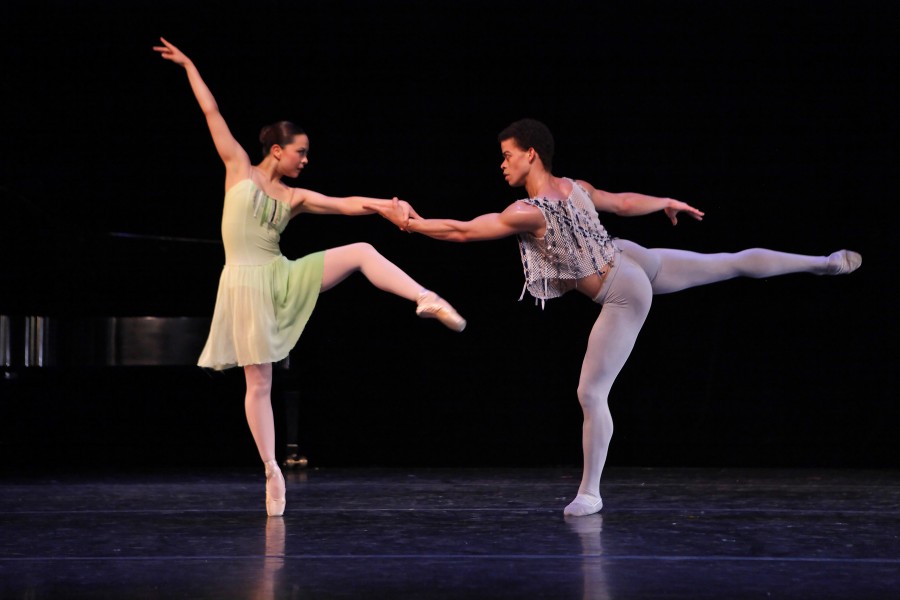
Once the gentleman has mastered getting the ballerina on her balance on one leg, they can move on to promenades, then pirouettes, and finally lifts. Promenades can often be more challenging than many spectacular looking lifts, because they require so much control and stability on the girl’s part. In a promenade, the girl must step into her position then maintain the shape squarely, allowing the boy to do the work of rotating her around on her pointe. Lots of adage work is key to being able to balance on one leg and hold extensions at the proper height in promenade.
Overhead lifts are usually practiced for the first few times with a spotter. And before doing them standing up you will often practice the shape of the lift with the man lying on his back on the floor, so if the ballerina falls she is never more than a foot from the ground. The strength and timing of the ballerina’s jump, and her back strength, are critical to the success of a lift. All a girl’s preparations should take slightly longer than if she were jumping alone, because she has to allow that split-second for the boy to react.
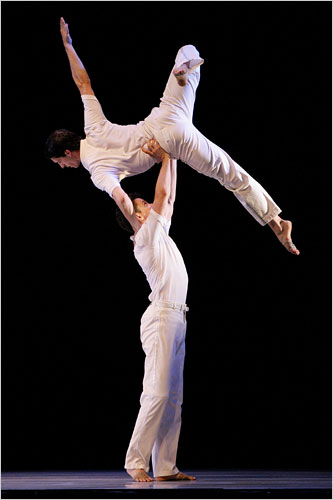
Ballet to the People recalls a series of rehearsals, many years ago, for a pas de deux featuring an overhead lift into cambré derrière, similar to the one at 2:20 in the Chopin Dances clip above. It was straightforward, simply requiring a straight-up jump into a backward arch, and it was a two-hander, so no big deal… All he had to do was plié, get under her and push straight up, then lock his elbows at the top. Except that B2TP and her partner were not well matched heightwise (she was 5’2” and he was 6’) so her jump had to be exceptionally strong, her flight path seemed so long that she half-expected a flight attendant to show up offering snacks – and she could not escape the fear, as she watched the fluorescent-lighted ceiling approach, that she would continue to sail backward and fall on her head.
Her partner had only been dancing for a year; he had given up college football for ballet. That he was very good at tackling big men and throwing them to the ground was not a great comfort. In rehearsal, the lift worked about two-thirds of the time; when it failed he always positioned himself underneath her to cushion her fall. There were no mishaps in performance. 28 years later, they are still married.


Leave a Reply