Leigh Donlan reviewed the Wed Jun 17, 2025 matinee performance at the Metropolitan Opera House in New York City
Visionary choreographer Wayne McGregor’s Woolf Works returned to the Met last week as American Ballet Theatre continues its summer season. This was its second New York outing; on my second viewing of this stunningly poetic and quantum-thinking ballet, I picked up visual and conceptual details I’d previously overlooked in this densely packed work, just as one often does when reading Woolf’s literature. Three distinct yet interconnected pieces sprung from three Woolf novels – Mrs. Dalloway, Orlando and The Waves – and traversed topics of quantum physics, gender fluidity and stream of consciousness, themes that Woolf explored in her early 20th century novels.
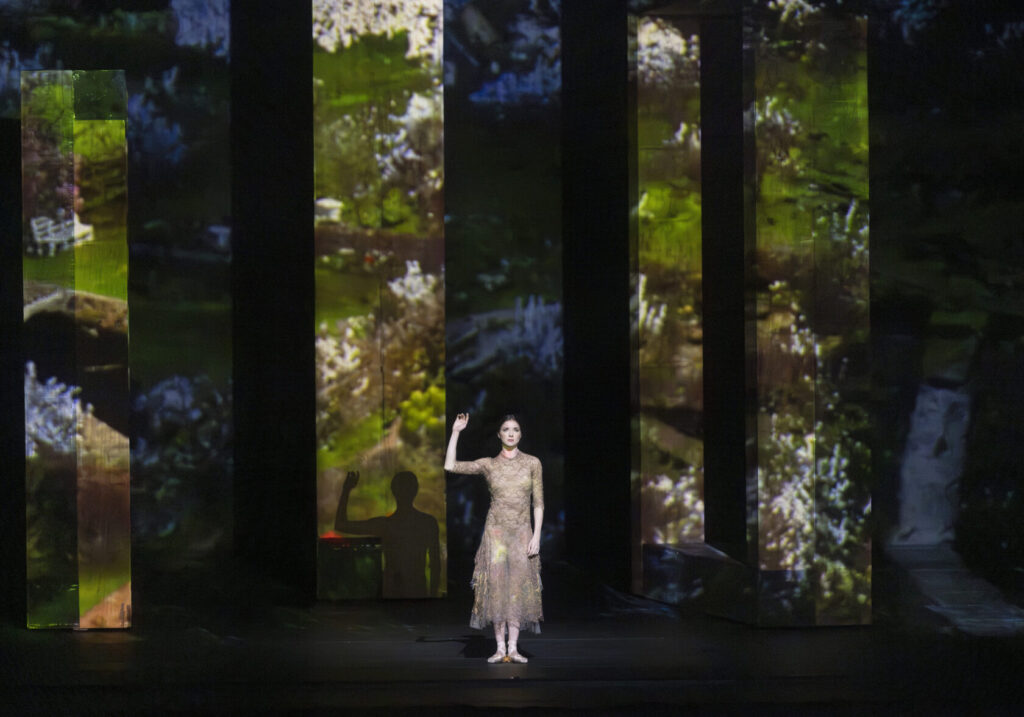
At Wednesday’s matinee, I now, I then (based on Mrs. Dalloway) opened with the dynamic Cassandra Trenary in her debut as Virginia Woolf/ Older Clarissa, alone on stage, in the dark. Her initial steps were unsteady, her movements hesitant, as if her body was a separate, foreign agency to her mind. Three massive wooden frames rotated centerstage within which individual dancers would intermittently seek reprieve and watch the entangled dancers at a remove. Roman Zhurbin as Clarissa’s husband Richard was a grounding and steadfast partner who brought his wife back to reality. In his presence, Clarissa lengthened her back and held her head high; Trenary expertly portrayed the complex characters, slipping on and off the societal masks worn by them, while revealing their inner worlds. A wave motif – a swimming motion of the arms and upper torso – unified the three parts of the ballet and heralded the final tragedy of Woolf’s life.
Calvin Royal III as Septimus – the shell-shocked war veteran – gave a heart-rending performance, wandering shoeless and coatless towards his ultimate suicide. His movements were fractured and shaky as he too lost grip of reality, yet softly fluid in moments of connection to other characters. On the brink of his death, he grew calm and radiant, even holy, as Woolf would later appear in Tuesday, the closing piece.
From the deeply human I now, I then, we were thrust into Becomings (based on Orlando) and propelled through a space of condensed time, place and identity, enhanced by well-choreographed laser light, designed by Lucy Carter, and Max Richter’s driving score. Last year I found some of the sound sections grating, but now I appreciate how he utilized instruments, often strings, and synthesized sound to build the momentum of the kinetic stream of stage movement, sculpting an aural landscape of objects falling through deep space, and sci-fi and cacophonous sounds. Dancers translated Woolf’s frantic stream-of-consciousness writing in bursts of McGregor’s grammar – reinventions and rearrangements of classical and contemporary vocabulary – while rushing on and off stage, appearing anonymous and interchangeable. One dancer posed like a softly curved ancient sculpture, then spun off like a spoked wheel. Two dancers moved like parts of a clock, one with rapidly winding arms, the other with ticking legs. The use of laser beams could have eclipsed the dance but effectively elevated it.
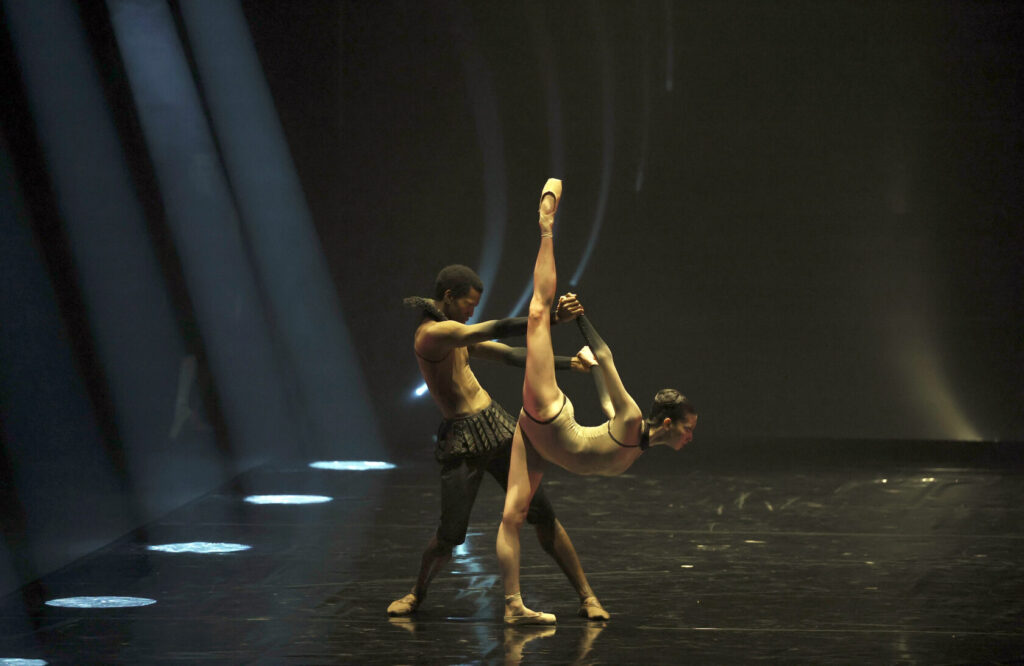
Misseldine and Royal momentarily brought us down to earth in a sensual duet. Beneath the celestial lighting, Misseldine perched steadily on Royal’s chest as he stood with his back slightly arched, her knees bent in a diamond shape, suggestive of a birthing position. His arms reached through her legs and up towards the light in an image of birthing new life.
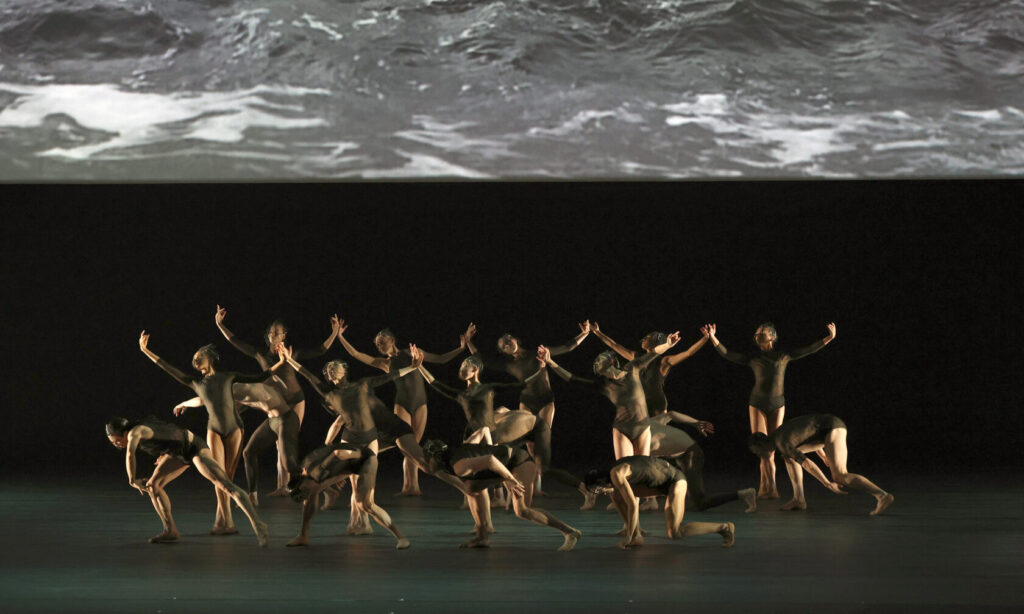
Tuesday (based on The Waves) closed the performance, bringing us to the water’s edge, then into the primordial womb of deep waters. Herman Cornejo, as Woolf’s honorable and devoted husband, Leonard, tenderly partnered and supported Trenary through a series of elaborate lifts. He stood with her balanced against the side of his torso, then raised her overhead as she appeared to swim towards an unseen surface. Then he swept her over his shoulders and down towards the floor as she dove deep. Cornejo exuded an immense stage presence though he navigated his character and partnering with modesty and utmost grace, steady as a rock in Woolf’s tempestuous sea. Isabella Boylston danced a warmly attentive sister and mother of six children, danced by JKO students who brought innocence and play, and a sense of rebirth.
In a powerful closing section, Trenary and the ensemble inscribed circles on the ground that turned into deep révérences, a final farewell from Woolf to the world and from the ensemble to Woolf, shortly before she took her final steps into the waves.
At the novel’s end, Woolf wrote: ‘There is no division between me and them. As I talked I felt “I am you”. This difference we make so much of, this identity we so feverishly cherish, was overcome.’
McGregor’s Woolf walked into the water and merged with the waves – the ensemble – who engulfed her and, for a moment, we lost sight of her. Trenary reappeared, sinking slowly. She and Cornejo shared a brief, gorgeously entwined duet before he laid her to rest, the last visceral image of this phenomenal modern masterpiece.


Leave a Reply