Carla Escoda reviewed the world premiere on March 9, 2026, at the Metropolitan Opera House in New York
The Met Opera last Monday unveiled a spectacular new production of Tristan und Isolde, mounting Wagner’s intimate night-drama on a cinematic scale.
Only days earlier, the company’s strained finances had been given a thorough airing in the hometown rag. And Kylie Jenner’s boyfriend had confided on national television that he had chosen acting over a “dying” art like opera or ballet – a contemptuous aside that opera and ballet companies worldwide have since gleefully repurposed in social media campaigns.
Meanwhile, a strong season at the Met, crowned by avid interest in Tristan, has underscored opera’s transformative power. The only dying occurred in Wagner’s fevered drama – paired, in director Yuval Sharon’s reimagining, with a striking image of rebirth: a newborn introduced in the final act. If anyone could make us believe that “how fondly he opens his eyes… how softly and gently from his lips sweet breath flutters” might be the words of a mother to her newborn child – and not, as generations of Isoldes have sung them, to a dead lover – the luminous Lise Davidsen could. Radiant after 240 minutes of sustained vocal heroics, she did.
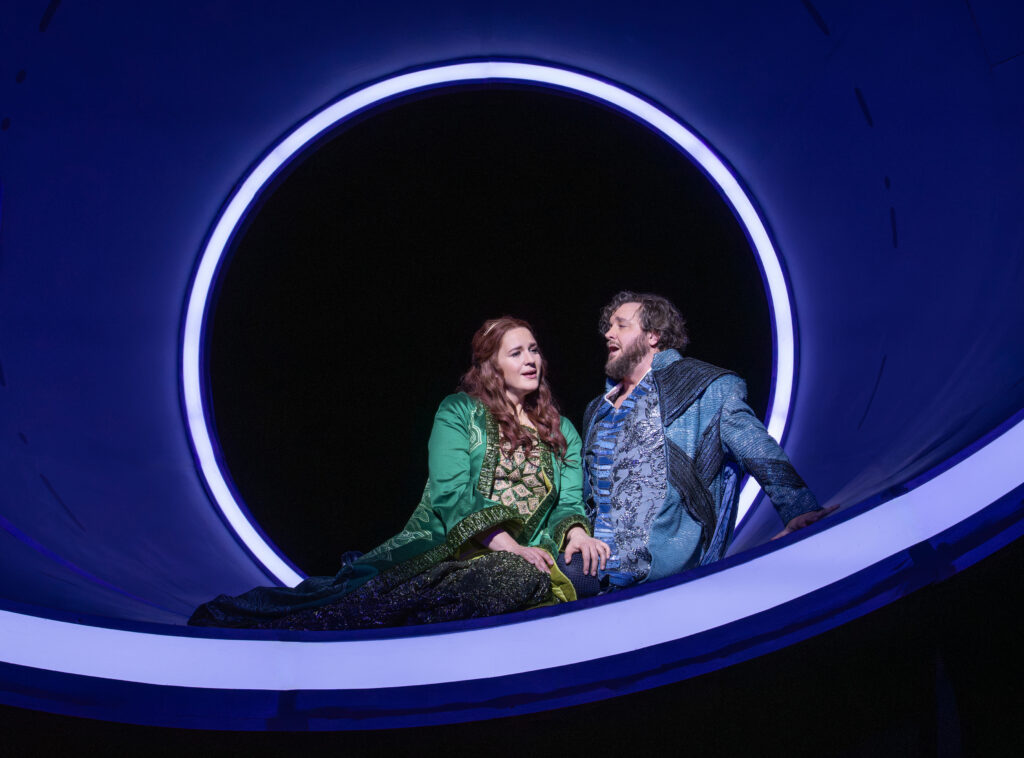
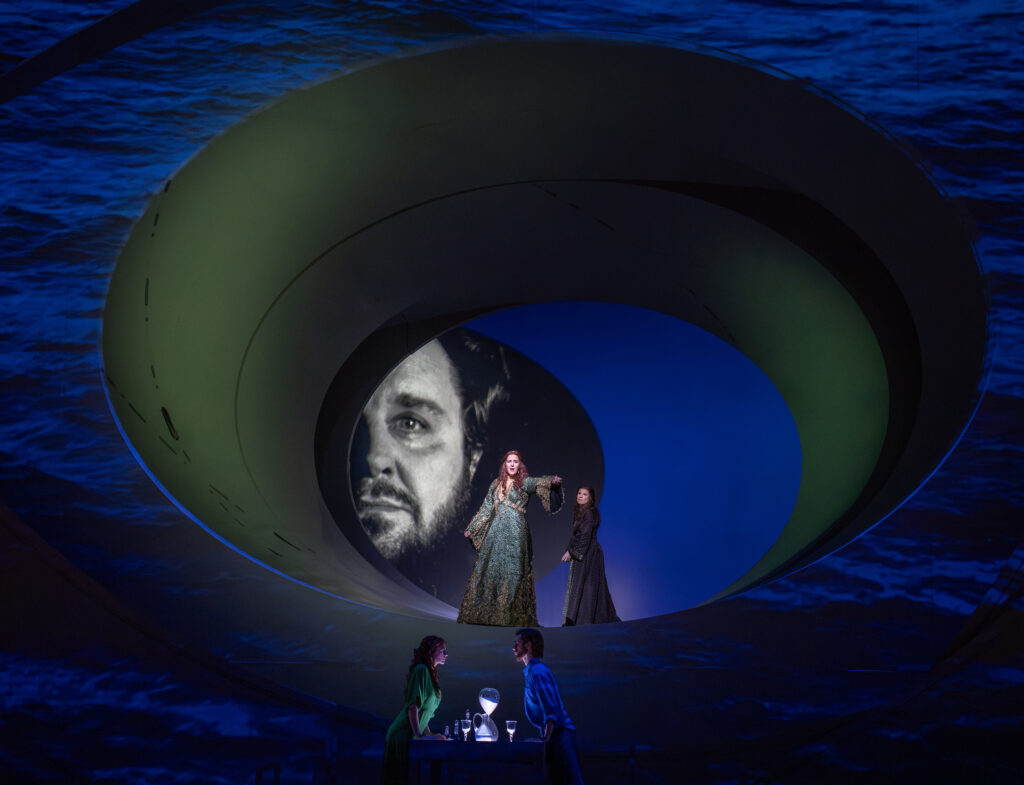
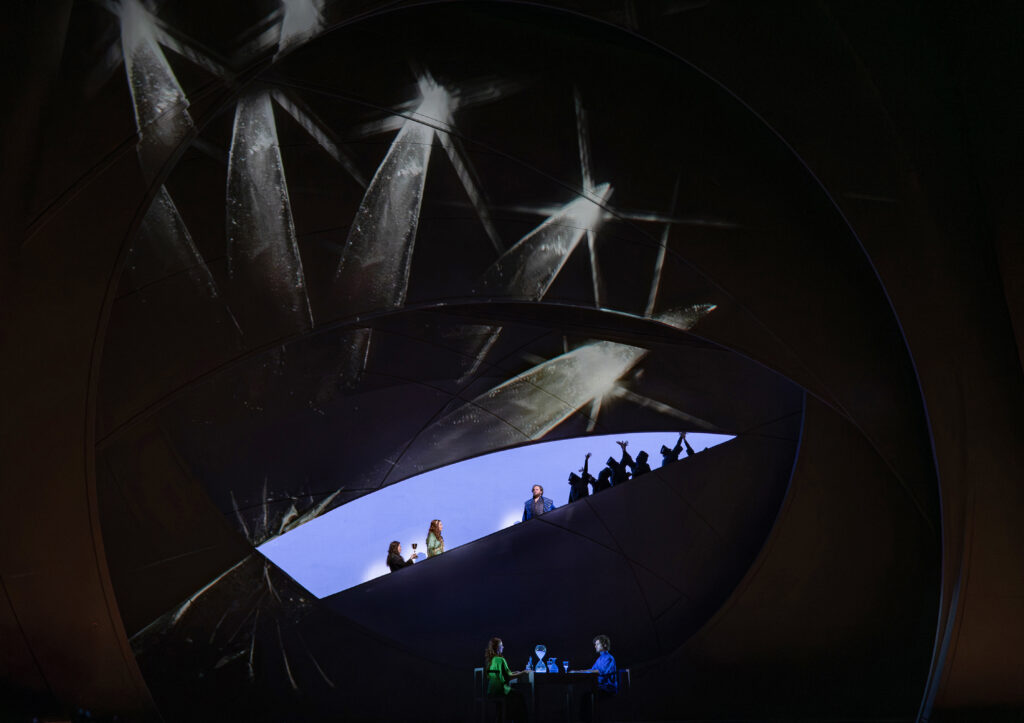
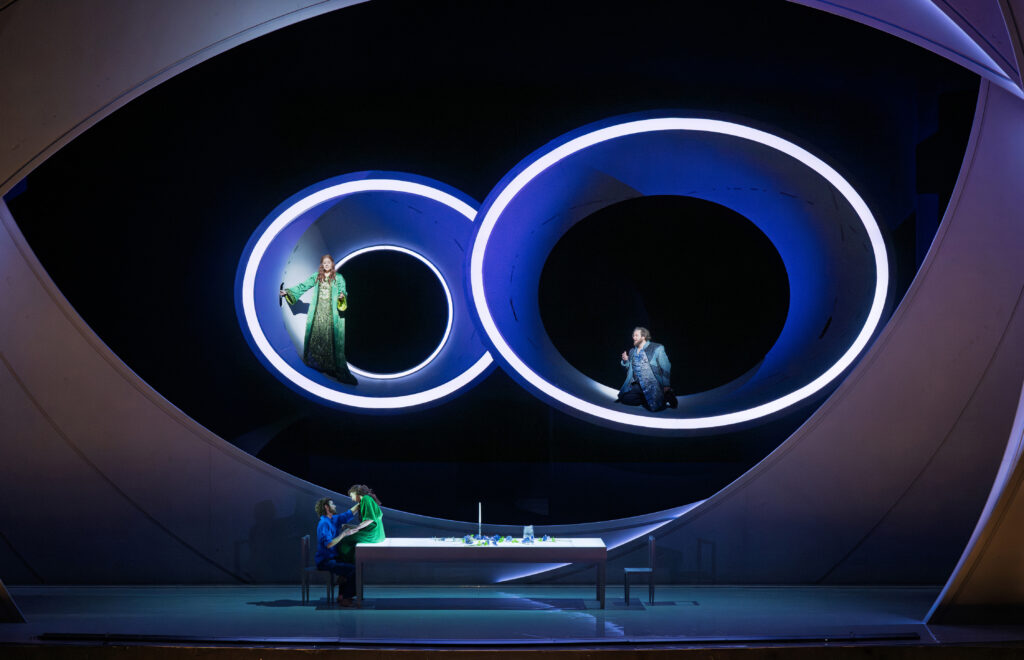
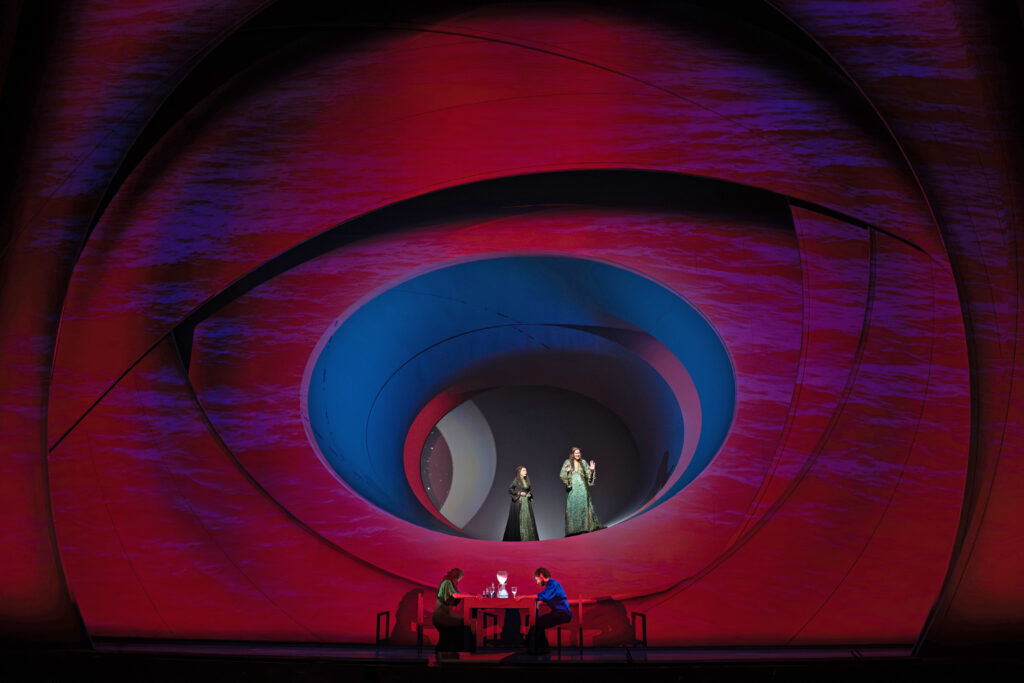
Wagner’s metaphysical drama unfolds within a “portal between worlds” devised by set designer Es Devlin: a structure hovering some three metres above the stage, its enormous blades opening and closing like the aperture of a camera to reveal telescoping tunnels. These glide horizontally, sometimes allowing the lovers to share a tunnel, sometimes carrying them past one another in separate ones. The impression is of a vast abstract mechanical eye – sometimes one, sometimes two – within which the states of love and death converge.
(Eerily lit by John Torres, the sleek architectural cavities recall Saul Bass’s title sequence for Hitchcock’s Vertigo: a swirling vortex spilling from the eye of actress Kim Novak magnified to fill the screen – the sequence unspooling to Bernard Herrmann’s ominous score, whose unsettled tonality echoes the Tristan Prelude.)
Below the floating orbs, the downstage area – site of the scenes with King Marke – is otherwise taken up by body doubles for Isolde and Tristan and interpretive dancers, who move in lento ceremonial fashion around a table. Projected onto the panels surrounding the “eye” is B-roll alternating with camera footage of the action. Among the more effective of these is the chilling image of a knife thrust by an Isolde-clone under the chin of a Tristan-clone, blown up and cast in bright light, its curved blade framing the scene in which the actual Isolde taunts Tristan into sharing a death cocktail with her.
Otherwise, the projections – a moth fluttering around the flame of a candle; shards of a dinner plate which King Marke tries to reassemble – amount to pedestrian metaphors. As do the ritual movements of the body doubles and dancers, who clamber on and off the table and distract from the stirring exchange between orchestra and singers. (If body doubles are critical to a director’s vision, surely there are more sophisticated ways to execute the swap.) The opening Prelude is accompanied by the lovers sitting across from each other at the table handling an hourglass like they were passing the salt – demoting the immortal music to backdrop.
These extraneous bits of stage and screen business served as unpalatable reminders that we are in the age of Timothée – dividing our attention, catering to instincts honed by the multiple devices attached to our persons, an insurance policy against our ever being bored for even a moment.
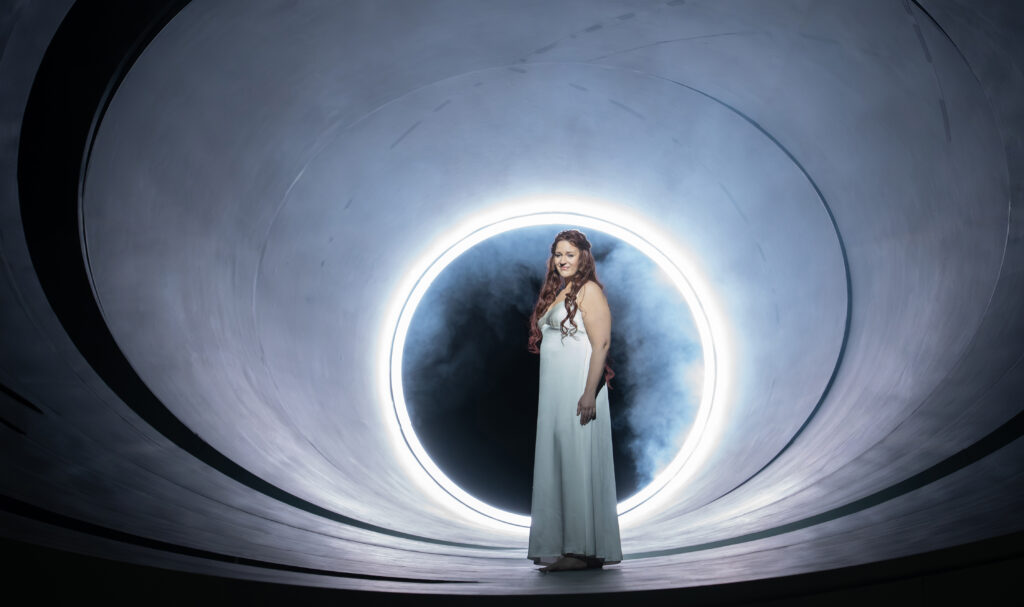
That extra business robbed us of precious time alone with Lise Davidsen, who unleashed ocean swells and gentle ripples of gleaming sound with a sense of wonder. She navigated a seemingly limitless range with ease. And her emotional coloring shifted with stunning facility: steely with contempt for Tristan in Act I, blossoming with desire in the love duet, shimmering and windswept in the final “Liebestod.”
From where I was sitting – far off to house right, coincidentally at about the same height as Devlin’s floating orbs – I had an expansive view of the formidable orchestra led by Yannick Nézét-Séguin with hushed restraint in the opening Prelude and growing fervor as the night wore on. The orchestral voice met that of Davidsen – and Michael Spyres as Tristan – like sea meeting sky in a Turner painting, bold strokes of color conjuring both storm and calm, the fragile and the implacable in a sublime dreamscape.
Yet in a few moments the balance between pit and stage was lost – most critically when I could not hear Davidsen’s final “höchste Lust!“ (“highest bliss!”) over the orchestra. I wondered whether that had more to do with where I was sitting and the acoustics of the tunnel from whose depths she floated those final notes.
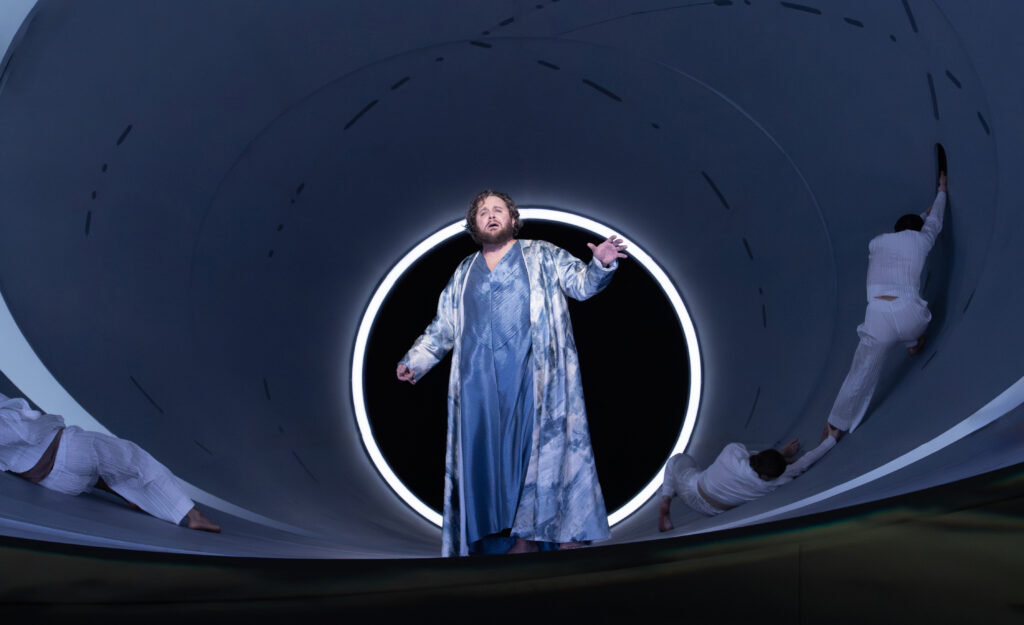
Spyres was making his debut – a triumph of vocal blending with Davidsen in both hushed and fevered moments. On a ship’s deck bound for Cornwall, where Tristan was to deliver Isolde to his uncle King Marke, he met her imperious demands with cold resolve. But once spellbound he sang of being “softly entwined in your magic, sweetly melted by your eyes” with easy, gorgeous lyricism. Hours later, mortally wounded by his former best friend, his vocal reserves undiminished, he cursed the light of day with explosive power.
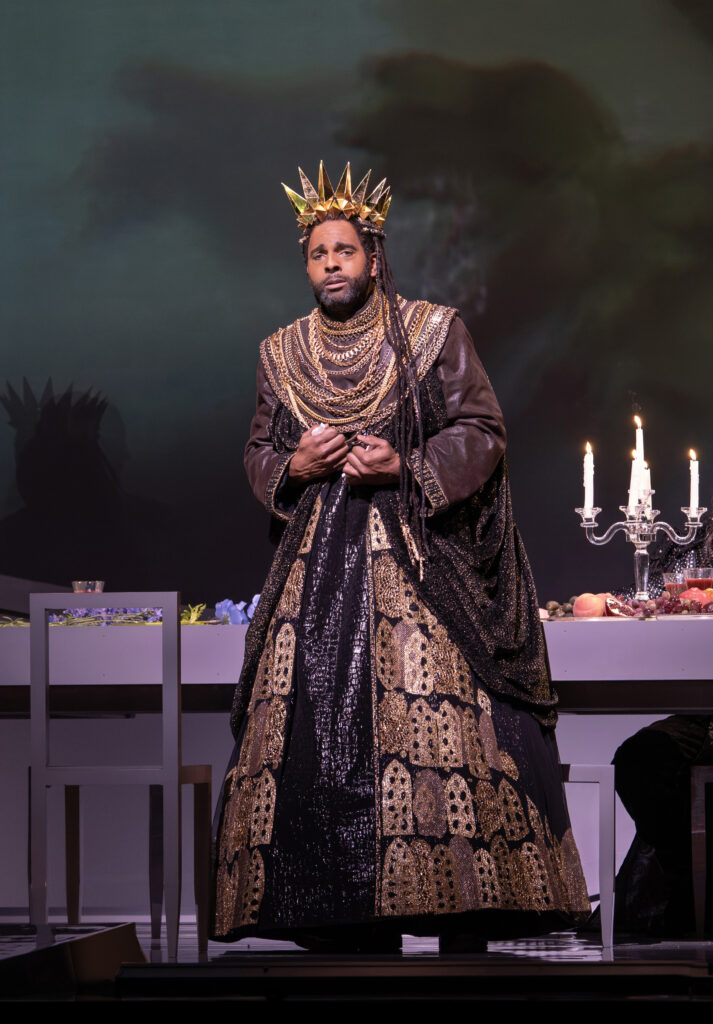
Journeying through the tunnel, Tristan is pursued by a pack of interpretive dancers in white loungewear and by the English horn soloist Pedro R. Diaz, whose “ancient tune of anxious yearning” seems to the bewildered, grief-stricken Tristan to ask: “For what fate was I then born?” When not dispatching a whirlwind of grave, wistful notes, Diaz trailed Spyres with the dispassionate air of a Secret Service agent assigned to protect him, clad in a robe of concertina pleats sculpted like a samurai’s kamishimo – one of two costuming triumphs by designer Clint Ramos. The other was King Marke’s voluminous robes, their abstract pattern faintly suggesting armor, topped by heavy gold chains and a spiky gold crown.
(The production wardrobe was otherwise unflattering: the statuesque Davidsen was saddled with a cartoonish vision of Ireland – Shrek-green robes and a copper-toned wig – while Spyres had to do battle with an ill-fitting shiny blue nightie that puckered at the chest.)
The supporting cast proved sterling, led by bass-baritone Ryan Speedo Green as King Marke, whose magnificent thundering and keening pierced our hearts just as Tristan’s treachery pierced the king’s. Tomasz Konieczny as Kurwenal and Ekaterina Gubanova as Brangäne projected dignity and passion, vocally and physically, emerging as wise confidants to Tristan and Isolde – their equals in insight, if not their social peers.
After singing her last words, Isolde turns and walks upstage toward the light at the end of the tunnel, enveloped in gauzy fabric. King Marke takes the infant from Brangäne’s arms and embraces it tenderly. We are meant to understand that the now-orphaned baby is Tristan’s, and that the noble, grief-stricken Marke has resolved to raise her himself. Yet the staging leaves little room for the possibility that the child might instead be Marke’s; after all he and Isolde have been married throughout the opera’s 65-minute Act II. Such ambiguity might have deepened the moment, adding another layer to the opera’s counterpoint between night and day, the individual and the world that survives him. Adding complexity to the reminder that, even as the music transcends the world of night, the world of day – with the continuity that a baby represents – endures.
In the age of Timothée, this stunning if overly busy production is likely to take hold in a way the morose Mariusz Treliński project of 2016 did not. It may even remind careless B-listers that modern art forms like movies were born of opera – and that Tristan and the like will be around long after the tragedies of ping-pong greats and the origin stories of fictional chocolatiers have perished. Whether it will cure the Met Opera of mining its endowment is a thornier question.
Tristan und Isolde runs until April 4th, 2026. The Met Live in HD broadcast in cinemas around the world is scheduled for March 21st at 12 pm ET with “Encore” dates on March 25th in the US and other dates elsewhere.
Leave a Reply