Carla Escoda caught the world premiere of Alexei Ratmansky’s The Naked King at Lincoln Center’s Koch Theater on 5th Feb 2026
Exquisitely timed, Alexei Ratmansky’s retelling of The Naked King for New York City Ballet dropped the day after a U.S. senator remarked: “Mark Twain could not have written a funnier thing about an ‘Emperor Has No Clothes’ than Donald Trump putting his own name on the Kennedy Center, installing a puppet board to do so, watching audiences and artists revolt and then deciding to cancel it.”
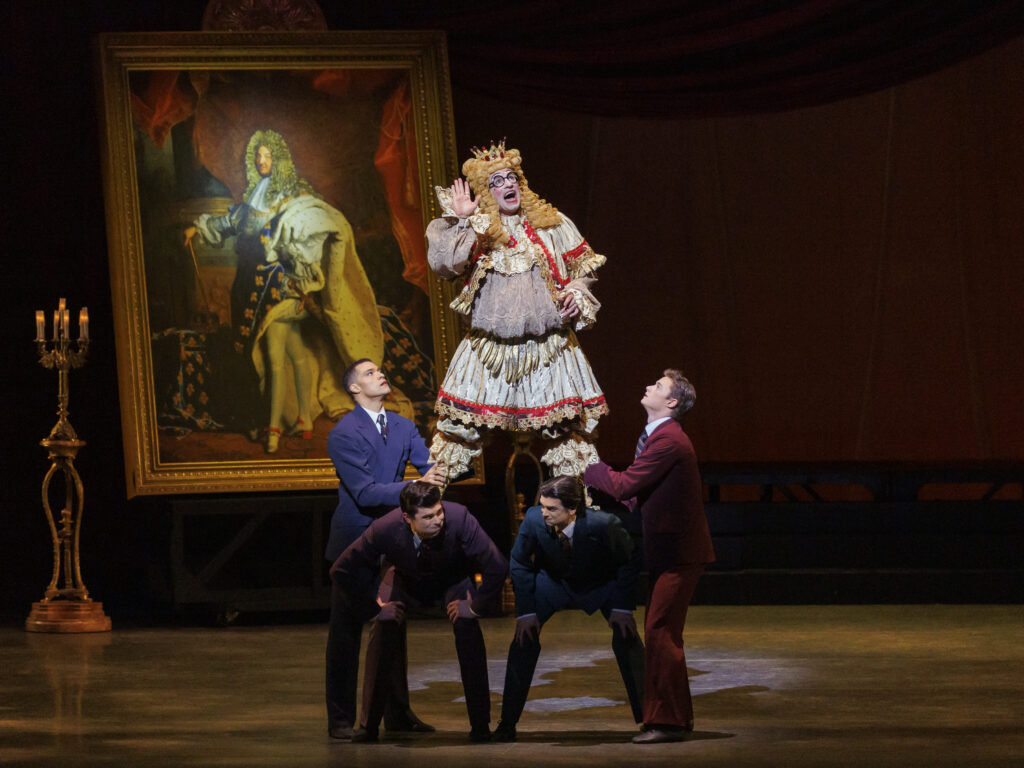
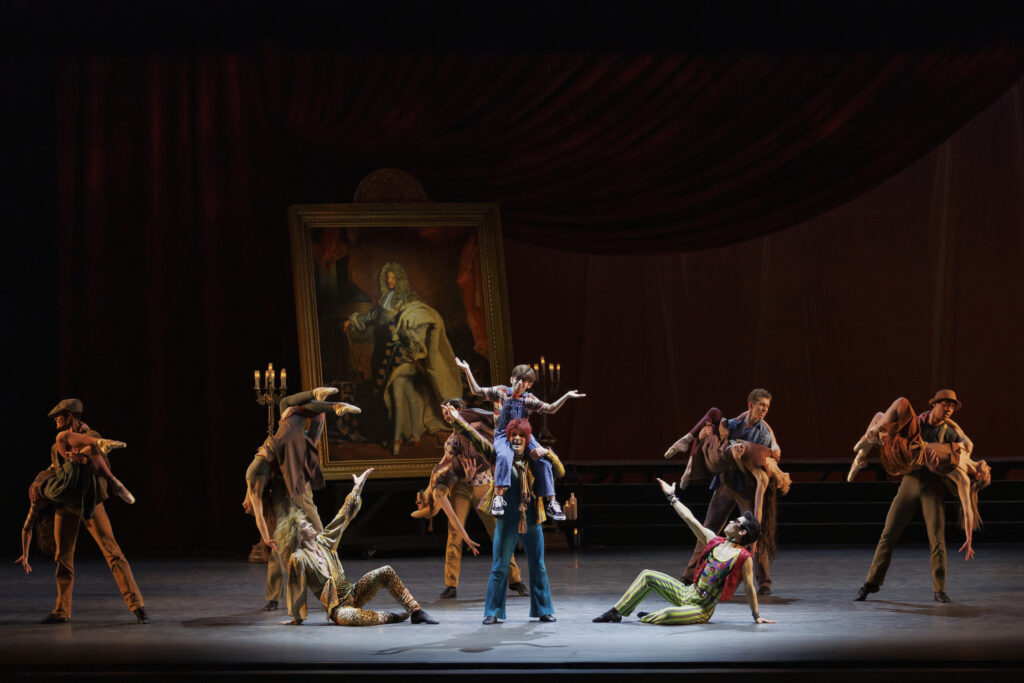
Ratmansky’s comic satire hit like a glitter bomb on Thursday night. He has made some of his most somber and moving work in fierce opposition to the Russian invasion of Ukraine and now adds humor to his creative arsenal. Though a reproduction of Rigaud’s Louis XIV portrait looms over the set, the king remains nameless – there is no shortage of deluded, self-absorbed tyrants, past and present, ripe for skewering. Santo Loquasto’s irreverent costume mashup ricochets from Bourbon splendor to Agnes DeMille’s Rodeo, Gilligan’s Island, Mötley Crüe and Halston, identifying no one in particular.
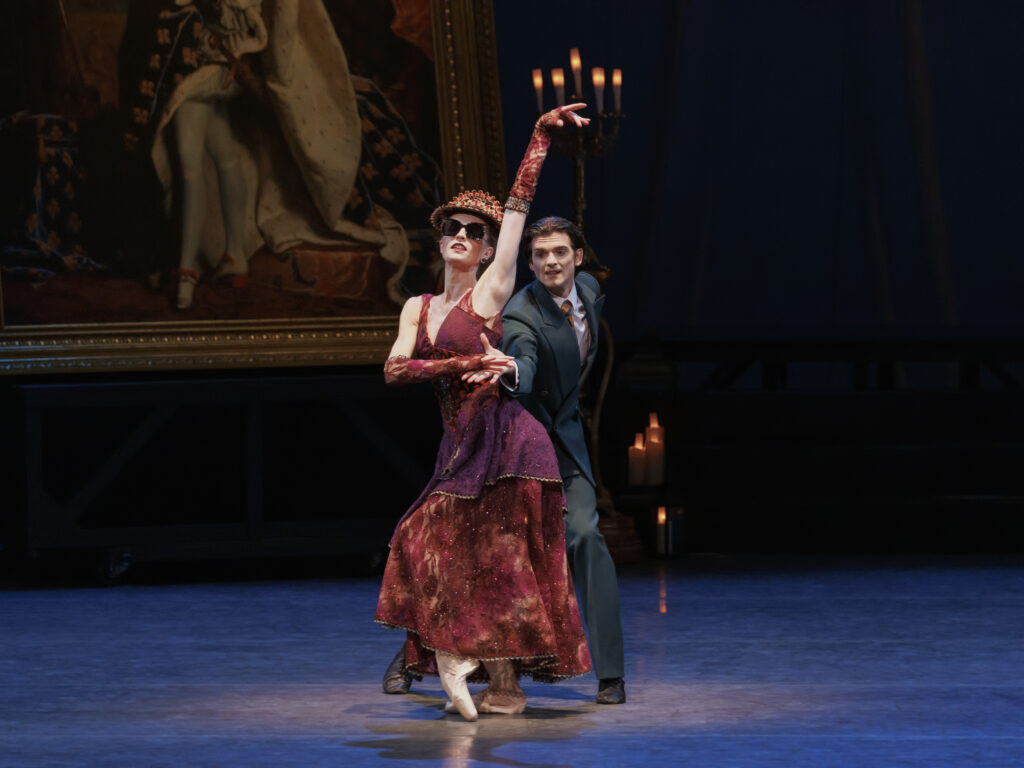
But New York is the town that birthed America’s narcissist-in-chief and a couple of tiny clues were no doubt picked up by just about everyone in the audience: Andrew Veyette, pitch-perfect in the role of a foppish nincompoop in a fat suit, flashed a toothy grin and a trademark thumbs-up. Miriam Miller as his sleek, apathetic Queen sported dark sunglasses and a fascinator with a brim, stacked her forearms and tapped out a vaguely Slavic dance, suggesting that she hailed from foreign climes. When she wasn’t displaying revulsion at her husband’s corpulent form in its bewigged, beruffled and bejeweled finery, she was carrying on with one of his sycophantic courtiers, uptightly and impeccably danced by Peter Walker. Together they flailed and Charlestoned and stole a few awkward smooches. Their twitchiness contrasted with the graceful exuberance of the ensemble Townspeople.
Veyette retired last season but tackled this Kingly role with heroic commitment, affecting a hilariously smarmy and sleazy manner. He minced and pranced in his high heels, stepped daintily on the bodies of his Entourage, basked in their ritual prostrations and directed them to lift and waft him through the air like a dirigible – this was both funny and poignant in its artistry. The King produced some petit allegro and even breezed through a few grands pirouettes, shamelessly milking his subjects (that included the audience) for applause.
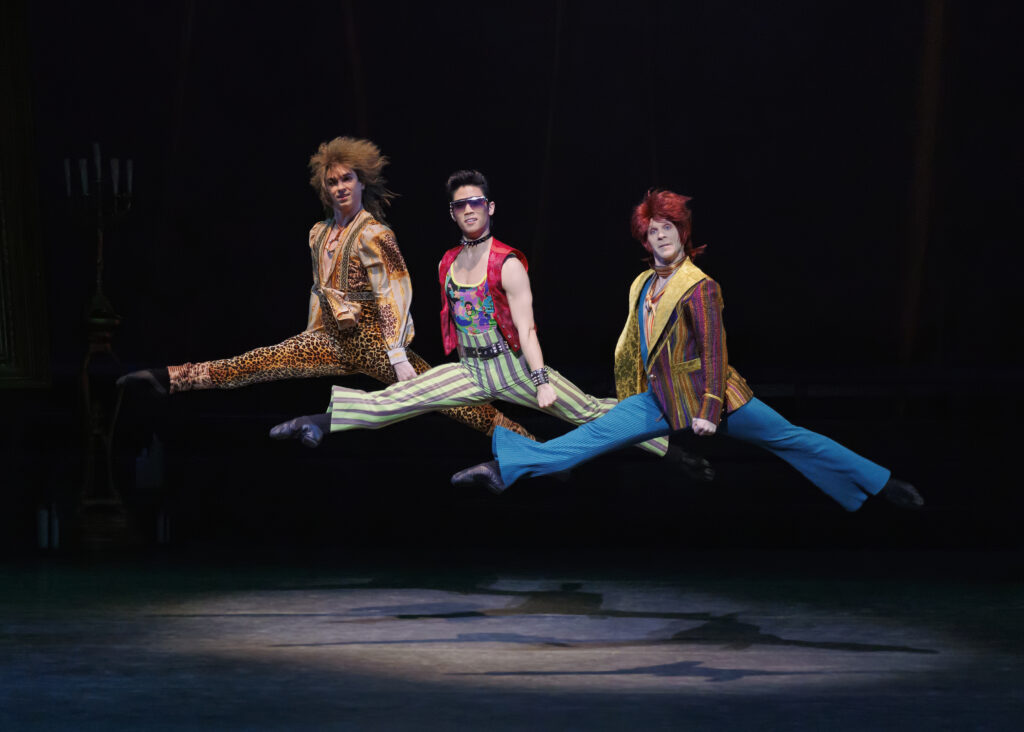
He proved an easy mark for three Swindlers – tailors in Hans Christian Andersen’s original story, here embodied by the brilliant David Gabriel, KJ Takahashi and Daniel Ulbricht, riotously outfitted in a glam-rock pastiche. With much bravura leaping and fervent gesticulation, they seduced the King into accepting a chic new garment allegedly endowed with a superpower that rendered it invisible to the stupid or incompetent.
Ratmansky reimagined the ending, diverging from Andersen’s original. In the 1837 tale, the Emperor is exposed when a child cries out, “The king is naked!” yet he carries on, sustained by the fiction of authority. His courtiers collude to treat the boy’s unvarnished truth as no threat to the crown. In his stories, Andersen repeatedly unmasks the cruelty and hypocrisy of the powerful while extending sympathy to the marginalized – though he stops short of urging revolution.
Ratmansky banished his King outright. Veyette seems to shrivel under the humiliation of exposure before the Townspeople quite literally boot him into the wings – but not before his exasperated Queen presses a fig leaf into his hands to cover the Vienna-sausage-sized appendage dangling from his fat suit.
Ratmansky’s reimagining contains enough ballet to satisfy neoclassical devotees – complete with winks to Balanchine’s Apollo and other iconic works – but not quite enough theatrical architecture to fully dramatize the King’s downfall. In Andersen’s tale, the climax unfolds as a grand procession: the Emperor parades through the city naked beneath an “invisible” canopy solemnly borne by his ministers, a spectacle that lays bare the elaborate machinery sustaining his authority. Ratmansky omits this display of pomp, forfeiting a scene that might have thrown the monarch’s ruin into sharper relief by exposing the very apparatus that props up the crown.
Instead, the Townspeople are simply milling about merrily when Veyette saunters in, clad only in his skintight fat suit. A boy suddenly runs in and delivers the fatal line. Directing the boy to speak it – rather than dance or mime it – registers as another missed opportunity. In Andersen’s story, the Emperor’s finery is fabricated from textual description, and his authority is undone by words; Ratmansky creates an uneasy asymmetry, pairing the Swindlers’ vividly choreographed deceptions with a spoken revelation from the boy – one that movement might have rendered more viscerally.
Brilliant, zany and brave, The Naked King is a rare illustration of moral indignation in ballet. The company is slated to perform at the Kennedy Center In Washington, D.C., in June, a month before the historic building will be stripped to steel girders. They should definitely bring this ballet.
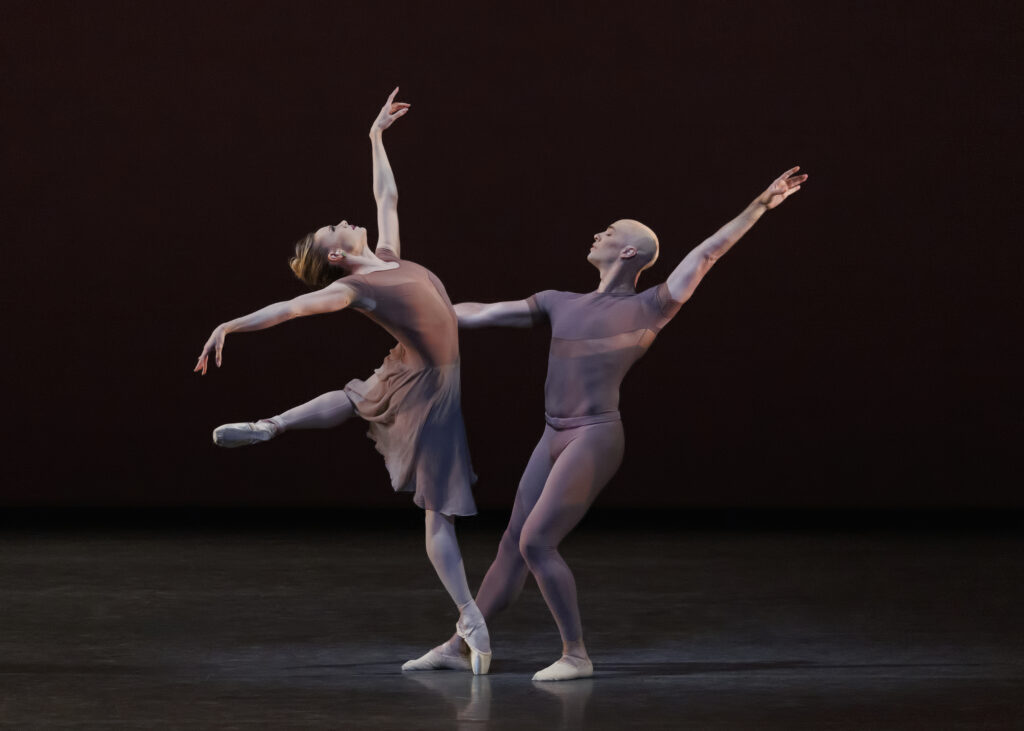
The other highlight of the evening was a moving performance of Chris Wheeldon’s This Bitter Earth. Sara Mearns carved long, lovely phrases of supplication with her magnificent sweeping arabesque while Tyler Angle kept her from tipping into despair.
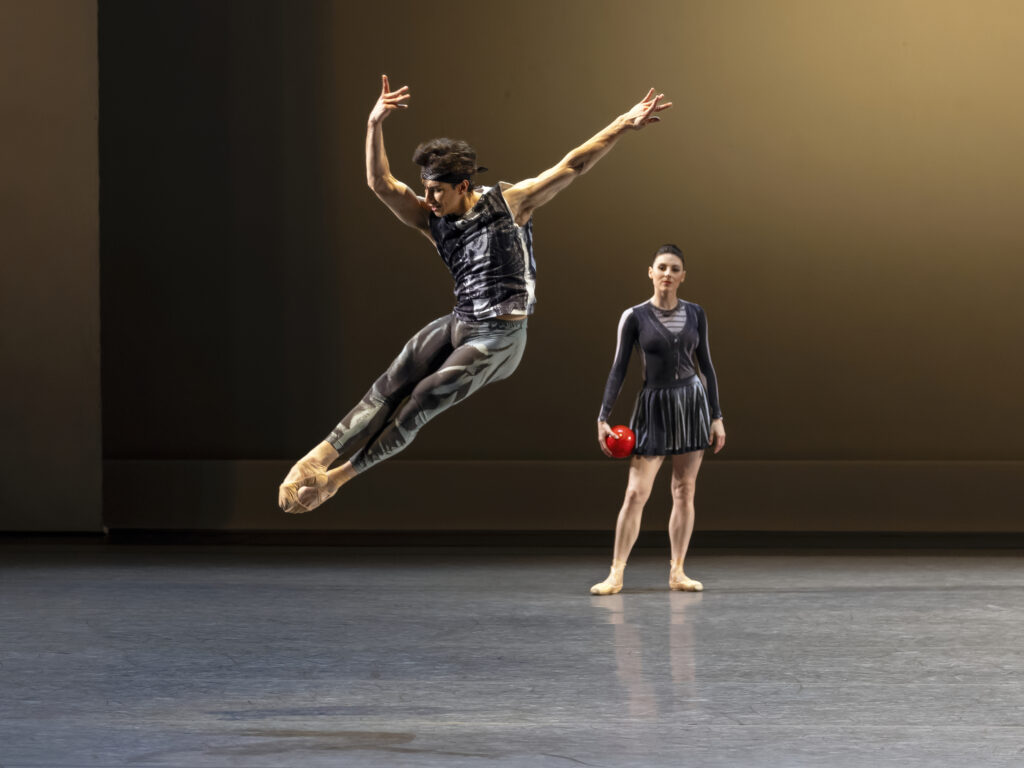
Two ballets by Justin Peck bookended the evening. In Dig the Say, ballet’s reigning It couple, Tiler Peck and Roman Mejia, tossed a red ball back and forth – trading the ball and trading solos packed with jazz-inflected jumps and pirouettes.
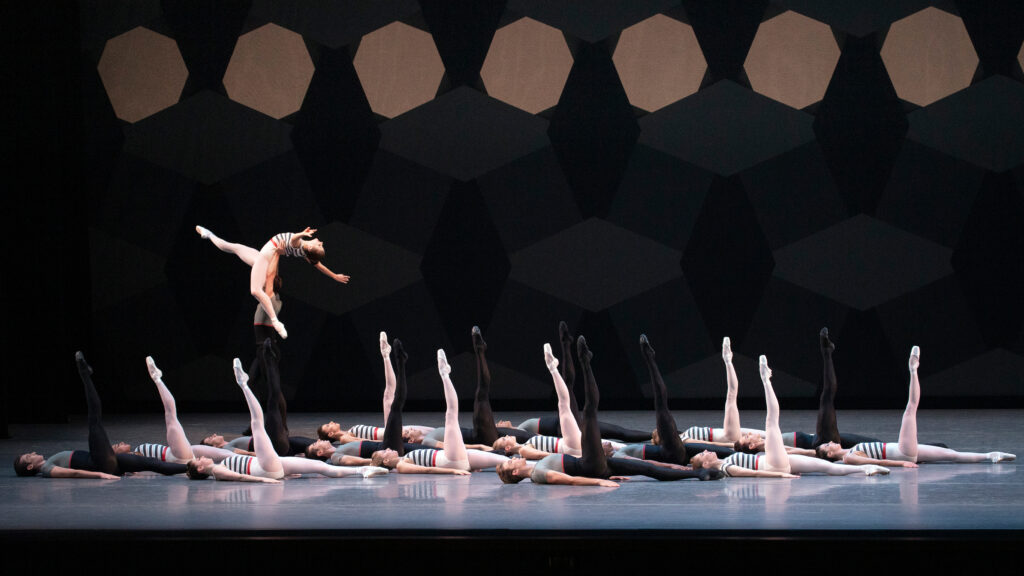
His 2014 ballet, Everywhere We Go, went everywhere more than once. Eternity passed, and another 22 minutes for good measure. The dancers would repeatedly lie down and hike one leg skyward like a bollard. This was charming the first time. They flung their arms outward as if warding off evil spirits. Ditto. One by one they collapsed in slow-mo while another dancer rushed over to ease their fall. In a post-COVID world, that imagery carried poignant new weight yet its reprise in the finale blunted the effect, signalling mere exhaustion. Adrian Danchig-Waring made poetry of even the plainest steps, his encounters with Dominika Afanasenkov shaping the ballet’s stirring emotional center.
Note: there will be two more performances of this program on 24th and 25th Feb, 2026: Contemporary Choreography II
Leave a Reply