Leigh Donlan reviewed the Wed July 2nd, 2025 matinee performance at the Metropolitan Opera House in New York City
New Yorkers got a second look at Christopher Wheeldon’s The Winter’s Tale this week, roughly a decade after the National Ballet of Canada brought it to New York and after a Royal Ballet broadcast was beamed into American theaters. Tackled now by American Ballet Theatre, the stellar cast I saw brought their mastery to the whimsical dancing and cinematic moments, yet the potholed narrative lacked emotional grip.
The subject of a tyrannical leader who destroys lives and his kingdom should have resonated with the stateside audience. Herman Cornejo as Leontes, King of Sicilia, took us on a turbulent ride as he descended into madness, consumed by jealousy. As Polixenes, King of Bohemia, James Whiteside provided dramatic flair and intermittent comic relief. Cassandra Trenary’s Hermione was a convincingly dutiful wife and mother. And as Paulina, the head of Hermione’s household, corps member Claire Davison heroically served as the moral compass and guiding voice of reason throughout.
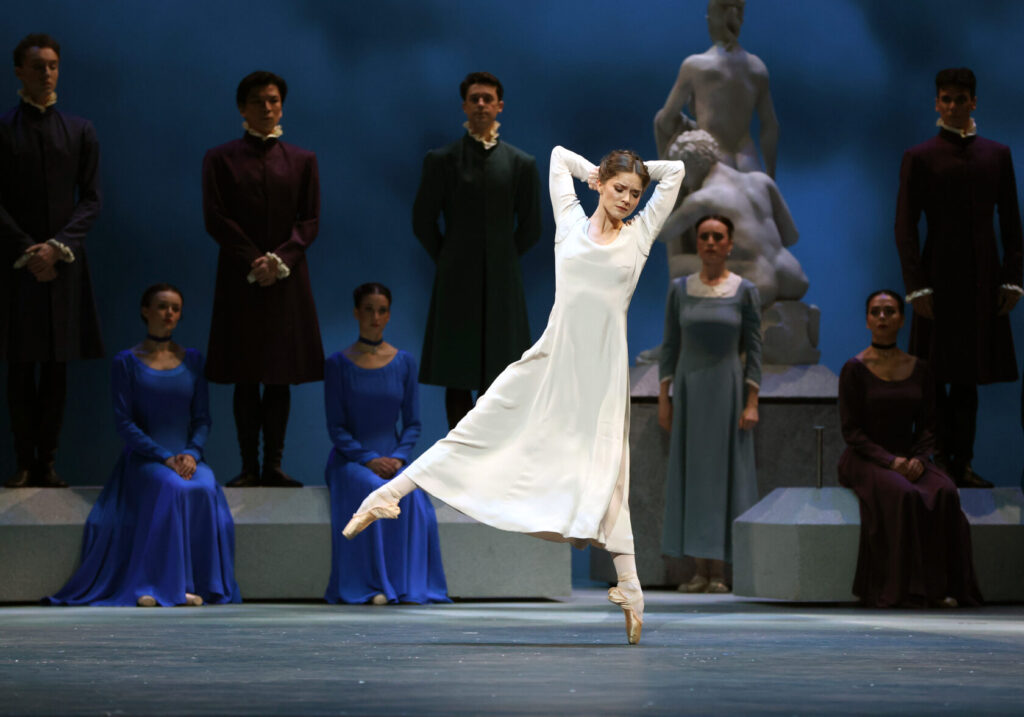
Story ballets and musical theater are Wheeldon’s wheelhouse, and his adaptation of Shakespeare’s final tragicomic romance – a collaboration with a brilliant team of artists, notably Bob Crowley (set and costumes), Basil Twist (silk effects) and Natasha Katz (lighting) – contains strong theatrical components.
Wheeldon’s story-telling however was not consistently supported by Joby Talbot’s predominantly formulaic score. There were some appealing moments during the Bohemian Court dances scored by East-Indian-influenced music and heavy percussive rhythms. Wheeldon’s quirky choreography included unexpected twists like flicked wrists, flexed feet, and bent knees on pointe, though this element of surprise quickly lost its luster, becoming predictable and redundant.
The set design for Leontes’ Sicilian palace in Act I – two-story high blank walls, a razor-sharp staircase, one throne and a rocking horse – evoked a prison asylum with its repressive atmosphere, the first of several brilliant Crowley sets.
Cornejo’s penetrating interpretation of the complex character of Leontes was the standout performance. Leontes’ jealousy was sparked when Polixenes casually touched the pregnant Hermione’s stomach. From there he slipped into delusion, believing that his very pregnant wife had an affair with his best friend. His mental unraveling was meticulously depicted by Cornejo’s spider-like movements: spindly, creeping, sharply pointed arms and legs, calculating and aggressive as he unexpectedly sprung upon his victims in fits of rage, slapping his palm against the foreheads of his perceived offenders. As his paranoia grew, he skulked behind four large stone statues, imagining the adulterous affair between his wife and best friend. Cornejo’s face grew sullen, his eyes vacant like pits of coal. He punched his chest and rubbed his hands frantically against his body, trying to erase his guilty conscience.
By the end of the hour-long, action-packed act, Leontes’ wake of destruction had left his wife and young son dead. Paulina managed to save his newborn infant, and shipped the baby girl off with her husband Antigonus. As often happens in Shakespeare’s worlds, karma struck and Antigonus, after abandoning the royal newborn on a seashore, is chased off and devoured by a bear. This creature is manifested by the first of many fantastical silk scrims designed by Basil Twist, this one painted with the colossal head and claws of a bear, that billowed over the scene.
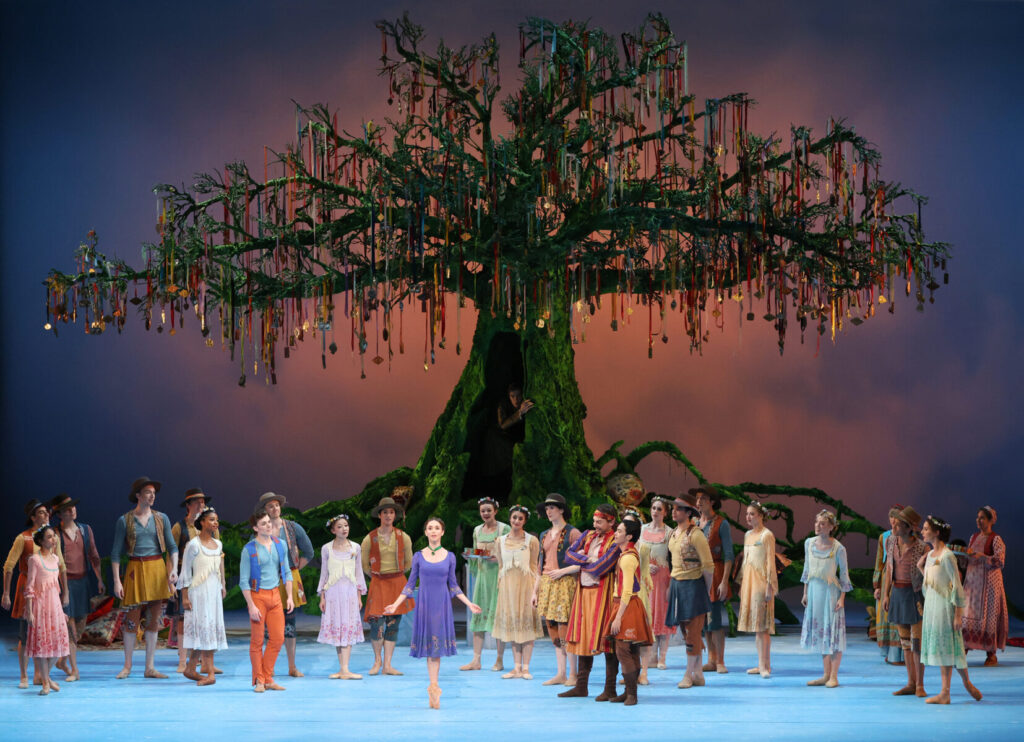
Act II takes place 16 years later in Bohemia, where a big and fabulous tree stood, adorned with hundreds of dangling ribbons in celebration of springtime. This vibrant Crowley construction filled the stage with sparkling branches and gnarled green roots, on which people perched throughout the joyous and hopeful act, in stark contrast to the sterility of Act I. Bohemia was now home to Perdita, the abandoned daughter of Leontes and Hermione who had been found and raised by a kindly shepherd, an exuberant Roman Zhurbin.
Winsomely danced by Skylar Brandt, Perdita was linked as if by fate with Florizel, King Polixenes’ son, portrayed by the splendid Jake Roxander. Defying the prohibition against marriage between royals and commoners, Florizel proposed to Perdita amid bustling village dances. But Polixenes objected to his son’s proposed marriage to a mere shepherdess, forcing the young lovers to flee to Sicily with the enraged father hot on their trail. They sailed on ships whose masts were projected onto fantastic billowing scrims which amplified a sense of danger in this ocean journey.
Back in third act Sicily, in short order, Leontes appeared to have repented and regretted his extreme and violent behavior. But it was too hasty of a clean-up and the act felt anticlimactic. Yes, 16 years had passed narratively, but just 30 theater-minutes earlier, Leontes was portrayed as abusive, morally bankrupt and insane.
When a memorial statue of Hermione came to life and all wounds were supposedly healed, under Paulina’s wise eye, even the reliable Trenary as Hermione couldn’t sell the idea of Leontes’ transformation into an honorable and loving husband and father; she seemed subservient and dutiful rather than motivated by love. Having suffered the loss of two children, mental and physical abuse, false accusations, public humiliation and sixteen years of involuntary exile, who can blame her for her low level of enthusiasm for a reconciliation?
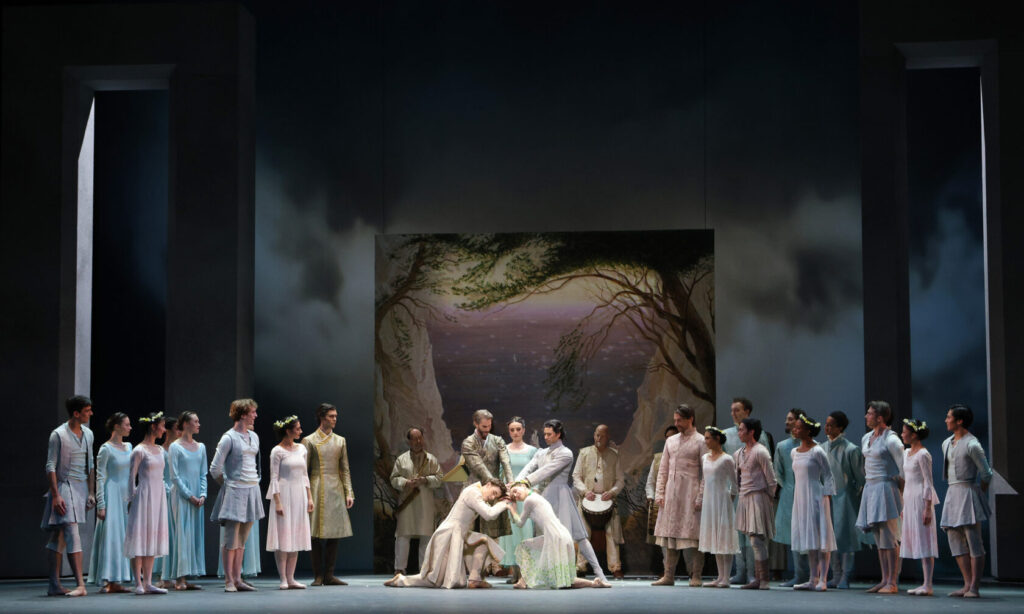
In the final wedding scene, pastel costumes didn’t provide much distinction amongst characters, and the washed-out palette of the set echoed the prison asylum look of Act I. Thus the dancing appeared mainly as a blurry stream of enthusiasm.
The use of larger-than-life sets, lighting and projections often carried this production, successfully distracting us from the narrative holes. The production was beautiful and the individual performances consummately polished, but the overall impact was purely entertaining.


Leave a Reply